Bipartisan Support For Making College Unaffordable
Let's face it. College is expensive. Unless you join the military or happen to come from a family that owns a bunch of oil wells in Texas, chances are you're going to leave college deep in debt. Many Americans don't dig out from under that debt for many years; many never do. The reason is quite obvious -- skyrocketing college tuition is making attendance virtually impossible without resorting to massive student loans.

Our Congress has decided to help out the little guy and make a college education a little easier to reach.
HR 5, College Student Relief Act of 2007, reduces interest rates for new federal student loans. It has passed the House,
356-71, with bipartisan support. It now moves on to the Senate.
This sounds like a great idea. It really helps the young American get an education, lift himself up, and improve the economy, right? There's no way this bill could possibly increase student loan defaults, since it reduces the size of the payment, right?
Actually, HR.5 will increase the pool of applicants who want to attend college, without increasing the number of students the college system can accept. The law of supply and demand dictates that college tuition must then rise and demand outstrips supply. Student loan sizes increase, thus resulting in higher student loan payments for those lucky enough to get them.
Student interest rates are currently tied to the average one year constant maturity Treasury yield (CMT), and thus follow the flow and ebb of the economy. Since 1998,
Stafford interest rates have dropped from 7.94% to 6.80%. The low rates (and high defaults) mean these loans incur significant cost to the average American in the form of higher taxes.
How low does HR.5 drop interest rates? Applied only to new students, HR.5 will lower rates each year until it bottoms out at
3.40%. That's right, less than half current rates, which are already low by any standards. What's more, HR.5 breaks the relationship between interest rates and the economy by making 3.40% permanent, no matter where the economy goes.
This is not a good use of taxpayer dollars. Not only does it not achieve the desired effect of making college affordable, it potentially reduces the income of college graduates, depressing the economy. The fact is that
too many Americans are going to college. Half of all Americans are below average intelligence, and no amount of education can change that. The economy requires doctors and lawyers, but it also needs waitresses, janitors, and bus drivers. How many college graduates do we really need? Currently 45% of all high school graduates enroll in a four year college!
The net effect of unreasonable high college attendance rates are multiple:
- Higher tuition, driven by supply and demand. Eventually, the market will respond by increasing capacity and accepting more students, leading to
- Lower wages for college graduates, based on the same principle. The increased number of college graduates and lower wages for graduates combine to produce
- Higher job qualification requirements. After all, if you have an excess of college graduates, which don't cost significantly more than non-graduates to hire, most employers will prefer the college graduate. Eventually a college degree becomes a requirement for jobs that previously were done by high school graduates. This further increases the demand for college education, leading to
- Lowered educational standards. As every American realizes that a college education is the only way to survive, the market responds by creating an educational system that allows every American to graduate.
This vicious cycle is already in place. Nobody will contest that tuition has risen, attendance is up, more Americans hold degrees, a degree is more important than it was in the past when it comes to job hunting, and our universities are failing to maintain high standards. This isn't a what-if theory about the future, it's an observation of the present.
As a culture it's time to drop the notion that everybody deserves the same. Every man is created equal, but what we achieve in life separates us. Only the students who excel in high school and prove the ability to perform at a higher level should be afforded the chance to attend college. To do otherwise demeans our entire educational system, and produces a nation of idiots with degrees.
Scappleface has a story on this issue as well.
Check it out.
Labels: education, taxes
Death and Taxes, and We're Working on Death
In this world nothing can be said to be certain, except death and taxes. -- Benjamin FranklinAsk any American history professor for the causes of the American Revolution, and high taxes is near the top of the list. But today, our taxes are several times higher than those paid by the colonists. Not just in real dollar terms, but in terms of the percentage of your labor that goes into government. What's wrong here?
Firstly, the government wastes money on non-essential functions. Unless you believe the fallacy that our government is more efficient than private industry, you must realize that every dollar spent by the government includes a "friction" charge of government inefficiency. Transfer non-essential services to private industry, and watch productivity go up -- and taxes go down.
Of course, certain functions remain central to the federal government, like national defense. Fortunately for us, there's a good guide already drafted that tells us which functions are essential and which are not. It's called the
Constitution, and it lays it all out in black and white. If it ain't in there, don't try to spend federal dollars on it.

The second step to reducing the tax burden is fixing the tax code itself. Beyond the millions of dollars spent to keep the
IRS running, how many billions are spent by companies and individuals trying to comply with the law? How many poor business decisions are made because a loophole will allow a tax-writeoff in excess of the loss itself? I can file my 1040 by myself each spring, but there's no man alive that can claim to understand the entire
US Tax Code, pictured to the right. This is insane.
Debbie (from
In the Bullpen)
blogged about a
Chicago Sun Times article on this subject, which caught my attention. You should all know I stand for minimization of federal spending outside that enumerated within the Constitution, but the way we collect that tax is important as well. Every engineer will tell you that each added complexity to a system will only add friction and losses. Our entire tax system is nothing but a collection of complex additions!
Rep John Linder is pushing for a solution. The
FairTax bill calls for a repeal of all current corporate and individual income taxes, payroll taxes, self-employment taxes, capital gains taxes, estate taxes and gift taxes. It replaces them with a single personal consumption tax (sales tax). Business-to-business transactions are exempt, as are sales of used items (already taxed). To remain progressive, individuals can obtain refunds on taxes paid on consumption up to the poverty level.
This is exceptionally simple, and easy to enforce. It eliminates the arbitrary double- and triple-taxation the current system entails. It's fair, and it will improve efficiency. We need folks like John Linder to help us break out of the "income tax is here to stay" mentality, think outside the box, and think of solutions for our country.
President Bush has formed a tax panel that is
recommending simplifying the system. Get in touch with your congressmen and tell them it's not enough to remove a few deductions. It's not just personal income tax that's fatally flawed, it's income tax itself. Don't use the government to discourage income.
Want to learn more? Visit
Americans for Fair Tax, and see what you can do to help.
Labels: state's rights, taxes
Nervous Rodent's Manifesto
 Last updated: 29 September 2005
I figure everyone has the right to know where a blogger is coming from, so I'm posting a manifesto of sorts. This isn't all-encompassing, but it should serve to give everyone an idea of where I'm coming from politically.
- The government that governs best, governs least. -- Thomas Jefferson
- Every service provided by the government is paid for out of the coffers of American wealth, e.g., taxes. To endorse spending is to postulate that the government can get more productivity from the wealth than private citizens, corporations, or organizations.
- It is not a crime that hurts none. All laws should exist to protect innocents; any law that does not is superfluous.
- The economy knows best. Only in the most extreme cases should the government interfere with the free working of the economy. Having said that, many problems are caused by government interference, and may require additional action to correct.
- All people have equal rights, and should be treated equally under the law. Giving privledges to one group over another to correct perceived "disadvantages" is insulting and degrading.
- It is better to fight for your country on foreign soil than at home. Like all rational people, I oppose war on principle. But I would rather fight in Iraq and Afghanistan than Maryland and Virginia.
- There is nothing wrong with religion. Except that no government should ever invoke it, for any reason. Government, by definition, has power over people, and the combination is dangerous in the extreme.
- All citizens have the right to argue and petition for change. Our Constitution has an amendment procedure for a reason. Violent action against a government is only justified against governments that do not, and it is especially justified in that situation.
- Debate and discourse of individuals is preferable to news and editorials dictated by major corporations.
- Opinions change, including mine. This manifesto may change with time. That's because I will, too.
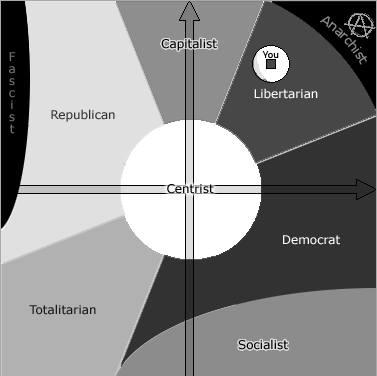
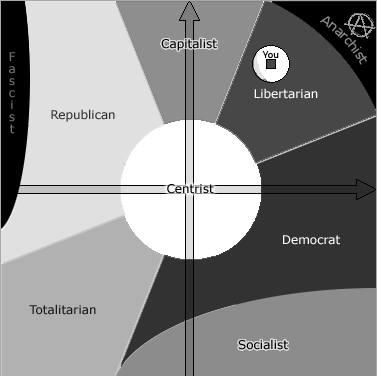
The images at the bottom give a bit of a clue. They are courtesy of the
OkCupid politics test. Feel free to take the test, and post your results as a comment so I can see what my readership is like. I'm 71% socially liberal, and 83% economically permissive. The first graph tells me I'm a Libertarian, the second tells me I'm similar to Jefferson, and the third tells me that people who scored similar results to me were split between Bush and Kerry in the last election.


Thanks to
Dave's Not Here for pointing me to this test.
Labels: afghanistan, church, iraq, nanny state, personal freedoms, privacy, racism, state's rights, taxes