I'll Wager On This
Is online gambling illegal in the United States? The Justice Department says so, citing the
Wire Act from 1961. Notably, the Wire Act only prohibits those "in the business of betting or wagering" from doing so, which has been interpreted to mean casual bettors were beyond the reach of the law, while gambling professionals and companies were not. So what happens when offshore gambling establishments allow Americans to log in and play casually over the Net?
Only
21 states have explicit prohibitions against social gambling, and only eight states specifically prohibit Internet gambling. What's an overzealous Congress to do? Pass a new law, of course! The U
nlawful Internet Gambling Enforcement Act of 2006 makes it illegal to transfer funds to or from an online gambling site, while not actually banning gambling itself. Predictably, this law has killed the Internet gambling industry -- Antigua's gambling industry went from $1 billion per year in revenue to only $30 million, resulting in a loss of 4,000 jobs in a country with only 68,000 people.

Even before that bill was passed, however, the Justice Department had been publicly stating that they felt Internet gambling was illegal, and would prosecute those who engaged in it. How many more people would have wagered online if they didn't have the spectre of
law enforcement hanging overhead? We may never know.
Here's the part that's interesting. Including indian lands, there are
1,657 casinos 46 states. Yes, that means a lot of states that make gambling illegal have an exception either for indian lands or specific establishments. So the question Antigua raised is, "Does Congress have the right to stop Americans from playing in offshore casinos when the majority of Americans can legally wager near home?" Funny thing is that's not just an ethical question; it's really a matter of protectionism and restraint of trade. Congress has stated that an American wishing to gamble must do it at an American brick & mortar casino, not with a foreign company.
So Antigua took the United States to the World Trade Organization, which whom we have signed treaties promising not to engage in protectionism or restraint of trade. America frequently petitions the WTO when foreign countries make it hard for American companies to compete overseas -- this is the first time any nation under 100,000 people has ever filed a complaint in the WTO. In 2004,
Antigua won: the United States was unfairly engaged in illegal restraint of trade.
The United States blatantly ignored the ruling, and passing the aforementioned law against online gambling two years later.
This week the WTO compliance board found the United States, not surprisingly, to
continue to violate international law: "The Panel concludes that the United States has failed to comply with the recommendations and rulings of the [Dispute Settlement Body] in this dispute."

So what does this mean? Absolutely nothing. Don't think for a second our politicians are afraid online gambling will create social ills and injure children, as they claim. Many of the states with explicit online gambling bans are those states with the largest gambling industries, including Nevada (373 casinos), Washington (143 casinos), and Montana (136 casinos). This is a clear-cut case of big business, namely the American gambling industry, pushing politicians to restrict American's freedoms for the sole purpose of reducing competition and ensuring higher profits. The largest sponsors of the 2006 gambling ban? Casinos, with
$28.5 million dollars spent in 2006 alone, or $53,271 for every Congressman in the House and Senate.
What should you do? Tell your congressmen to give Americans the freedom of choice. Support the
Poker Players Alliance, the strongest group lobbying for the legalization of online gambling, with 319,307 dues-paying members, and headed by former Congressman Alfonse D'Amato. And always remember it's not the job of our government to hand money to special interest groups on a silver platter.
Labels: personal freedoms
RIP COPA

In 1996, the
Communications Decency Act was passed, making it illegal to make obscene or indecent material available on the Internet where a minor could access it. The nascent Internet community reacted, with an
estimated five to ten percent of online websites switching to
black backgrounds (including
Yahoo!) for 48 hours, and a massive "blue ribbon campaign" that saw
blue ribbons on thousands of homepages for several months.
The law was never enforced, as a federal panel of judges enacted an injunction against it, and by the next year it had been overturned completely. A horrible law that died a quick clean death.
So, given Congress's penchant for attempting to pass an unconstitutional law by ramming it down the public's throat, the measure was pushed through Congress the following year (1998) under a new name, the
Child Online Protection Act (COPA). COPA limited the restrictions to commercial enterprises, but clarified the obscenity requirements to include all nudity, including female breasts. Medical health sites were among the many outraged by the new law, which would have required a credit card or other proof of age to access information on how to perform cancer self-exams.
The law was, once again, subject to an immediate injunction. The following year, the law was struck down. However, unlike the CDA, it was not quickly killed. The Attorney General chose to appeal the ruling, and by 2004 the Supreme Court reviewed the case and upheld the unjunction, but referred the case to a lower court for trial.
The Department of Justice then issued subpeonas to various Internet search engines for search records. All search engines complied except for Google, which
successfully fought the subpeona as illegal. The trial finally commenced, and this Thursday,
a verdict was reached. COPA is finally dead, having been found to facially violate both the First and Fifth Amendments to the Constitution. Senior U.S. District Judge Lowell Reed Jr. said in his ruling "[P]erhaps we do the minors of this country harm if First Amendment protections, which they will with age inherit fully, are chipped away in the name of their protection."
I have only two worries. The first is the inevitable third try Congress will attempt now that COPA is dead. The second is that this judge appears to think that you have to be eighteen to have free speech.
Labels: free speech, nanny state, personal freedoms
Global Online Freedom Act of 2007

Some bills are good ideas, and a great many are colossally bad ideas. Every now and then you get a bill that does a good thing the wrong way, and that's what the
Global Online Freedom Act of 2007 is. Introduced by Rep Christopher Smith (R-NJ) as a rework of the failed 2006 version, the bill is
currently sitting in the House Energy and Commerce Committee as well as the House Foreign Affairs Committee.
So what's all this about then? Here's a short history on the why of this bill:
- In 2005, Yahoo! provided information on a Chinese journalist who released an internal Communist Party message anonymously via the Internet, leading to his arrest and 10 year prison sentence.
- On Dec 31st of the same year, Microsoft removed a blog of a Chinese journalist. Microsoft had earlier that year admitted to censoring words like "freedom" and "democracy" from its Internet portal.
- Early last year, Google admitted that it censored search results for users in China.
What do all three events have in common? In all three cases, the companies stated they were simply complying with Chinese law, and had no choice.
In February 2006, the House held a
hearing in with Representative Tom
Lantos said "Your abhorrent activities in China are a disgrace. I simply do not understand how your corporate leadership sleeps at night."
It should come as no surprise to anyone that I abhor the thought of China censoring the Internet, and it sickens me that American companies are profiting from helping China through pro-democracy activists in the Gulag. But about this bill? Does the ends justify the means? Is the cost worth the result? I don't see a problem with Congress regulating international commerce, that is, prohibiting U.S. corporations from performing certain acts on behalf of foreign governments. There are three basic elements of the bill that bother me:
- The price tag of $50 million per year. What the heck is going to cost fifty million dollars per year? How hard is it to tell which countries are censoring the Internet?
- The massive reporting requirements. Anyone who removes any content from any server on behalf of a foreign government is basically required to describe the circumstances behind the removal to the State Department. Perhaps the $50 million is to pay for federal workers to read all these reports, but who's going to pay for the guys who waste time writing them?
- Export license restrictions. The bill tasks the Secretary of State to perform a feasibility study on restricting export licenses for products that facilitate restrictions on Internet freedom. Almost all networking technology can censor in some fashion, whether operating system, firewall, or router. Could this snowball into a situation like we had in the 90's where all decent cryptology was prohibited from export, holding computer security back for years?
My mind isn't made up quite yet. I offer this post primarily as food for thought. Chew deeply, unless you're in China, in which case you won't be able to find this blog that talks about democracy and freedom.
Ironically,
China denies censoring the Internet at all. Not that anyone believes them. Maybe the Chinese do. After all, if you search Google News from within China, I bet you won't find any evidence of censorship.
Labels: China, free speech, personal freedoms, privacy
The People have spoken.... But I don't care!
Let me start by saying I hate blue laws. They are unconstitutional by any measure, as they specifically honor the preferences of a certain sects of a single religion over all others. When someone tells me they support blue laws, I generally ask if Christians should be banned from purchasing alcohol in Muslim-majority towns, because they are coming to America fast. As Christians represent an ever-shrinking percentage of America, they will quickly look to the Constitution to defend them from other religious beliefs.

So, why do I bring this up? Any regular visitor to the Nervous Rodent would quickly recognize that I would oppose a law to restrict the sale of alcohol based on a religious belief. I bring it up because there is a bill in the Georgia General Assembly to (finally) partially limit the blue laws so pervasive in the South. Namely,
Senate Bill 26 would allow each county and/or municipality that currently allows the sale of alcohol the option of allowing a referendum in that area to allow the sale of beer and wine (not liquor) on Sundays.
It's hard to be against that, isn't it? It allows each town and/or county to decide for themselves if they want to limit blue laws to hard liquor. It's not a perfect solution, but it's far better than the current law.
As
Crazy for Liberty points out, there is widespread support among both the population and representatives in the government. Somehow the Governor, Sonny Perdue, is against it (
sound clip,
AJC link):
I think it’s going to have a tough time, actually. When you ask people generally if they want the right to vote on anything — what kind of toilet tissue the state ought to use, or anything like that — they’ll typically say yes.
Although they like representative government, they like to have their voices heard. And that’s why we have representative government, where people elect their own legislators to come and make these kinds of decisions.
Some things rise to the level of referendums — such as, I felt, the symbol, the flag that represented Georgia, which I felt rose to that level. But you can’t do government really by referendum. And so, I don’t support that, and I don’t know whether it will pass the Legislature or not, but it’ll have a pretty tough time getting the last vote….
You have to always be attuned to where public opinion is, but it doesn’t necessarily mean you have to follow that. A good leader always leads in a way they think is the right direction for Georgia on significant issues. …
What? Yeah, the people want more freedom and less government intrusion, but that doesn't mean I'm going to give it to them? Remember Georgians, you voted for him!
I have to credit Sonny Perdue with one thing, however. He is the first person I've ever heard come up with a valid justification for blue laws that doesn't mention religion -- the government's responsibility to educate the populace:
Think of it this way…It really helps you plan ahead for the rest of your life — buying on Saturday, rather than Sunday. Time management.
Hey, I've got an idea. Let's only sell gasoline on odd days, milk on even days. Condoms should only be sold on prime-numbered days. We'll make everyone plan their entire week around a couple of random proclamations with no justification other than making people's lives harder so they can learn to deal. After all, that's why government exists.
Labels: alcohol, church, personal freedoms
It's Different on the Internet...

The
RIAA is at it again, and this year they've got Sen. Lamar Alexander (R-TN), Joseph Biden (D-DE), Dianne Feinstein (D-CA), and Lindsey Graham (R-SC) backing them up. Specifically, those are the sponsors of the
"Platform Equality and Remedies for Rights Holders in Music Act" (PERFORM), which was introduced (and failed) in 2006 and
re-introduced Thursday. (Last year it was only sponsored by Feinstein and Graham)
In a nutshell, the law requires satellite, cable music, and Internet broadcasters to "use reasonably available and economically reasonable technology to prevent music theft." It also would have the government responsible for determining the royalties paid to music companies for the use of music libraries over these media. It also requires all Internet, satellite, and cable broadcasters to incorporate DRM (digital rights management), that same technology that prevents some CDs from working in computers, lots of MP3s from working in certain MP3 players, and generally making it hard to put music in the form you want it. Note that Live365, Shoutcast, iTunes streaming, and the majority of small webcasters use MP3 or other non-DRM'ed technology to broadcast, meaning the majority of webcasters would have to develop new technology to comply with this bill.
Under current law, broadcasters cannot actively assist listeners in pirating music. They are required to use DRM,
but only if the format they are using has DRM features. The changes put the FCC in the role of forcing broadcasters
of digital music to adopt technologies that prevent consumers from copying (or time-shifting) broadcasted music.
Yes, it's illegal to pirate music, whether you do it via FM radio, satellite, or the Internet. However, under the
Audio Home Recording Act of 1992, Subchapter D, you can legally make analog or digital copies of broadcasts (time-shifting, or recording for later playback, has consistently been upheld as fair use by the Supreme Court). This bill changes that by making it illegal to copy digitally transmitted music, while still allowing analog music. Check out the
EFF article about last year's version for more information.
Ironically, Senator Sununu (R-NH) has
announced that he intends to introduce a bill that will prohibit the FCC from enacting technology mandates, such as the broadcast flag and other DRM-like technologies. Should such a bill pass, it would prevent the FCC from enforcing S.256.
It's really simple folks.
Fair use is fair use, and there's nothing wrong or illegal about copying a broadcast to listen to it at a later date. There is something wrong about copying your favorite songs off the radio and creating a mix tape. Unfortunately there's no way to build a technology that allows one but prevents the other, because the intrinsic difference is
intent of the end user. The government should not restrict freedoms of broadcasters to use the technologies they want, nor restrict the freedoms of individuals to exercise fair use rights, in an effort to prevent illegal pirating of music. And I'm sure everyone except the RIAA will agree the government has no business setting the royalty rates for music.
Write your Senator to complain about this one. Also, register at
govtrack.us, an excellent website that allows you to research virtually any action by Congress. You can have daily updates sent to your inbox, showing all activities by certain representatives, on certain issues, or on certain bills. Or just see everything (but prepare for lengthy e-mails).
Labels: personal freedoms
How to Get Free Airfare
You're going to love this one. I hate to even write about it -- I want to tell you to just
read the Washington Post article, then come back.
Okay, I know you didn't click on the link, so here goes:

Tommie Rice was arrested in Nashville for driving on a suspended license. When he was taken in, Tennessee police ran his name and saw that he was wanted for murder in
Gaithersburg, Maryland. Although he insisted he'd never even been to Maryland, he was flown to Maryland to face trial.
Tommie Rice spent three weeks in jail, including Christmas and New Years, before anyone checked his fingerprints. Guess what? There's more than one person named Tommy Rice in America, and this wasn't the right guy.
Let's hear it for police that fly a suspect halfway across the country without even checking his story. Or even his fingerprints. Let's hear it for a three week imprisonment without evidence. And most importantly, let's here it for what Maryland finally did when they realized their mistake:
They drove him to a homeless shelter.
Since his release, Tommie Rice has been calling relatives trying to get them to lend him money for a flight home. In the meantime, Montgomery County Sheriff
Kight has said he would "try" to get him home. "We definitely owe him a ride back to Tennessee and an apology," he said. Kind words for a man you held without evidence for three weeks, then dumped in an out-of-state homeless shelter.
You owe him more than an apology and a ride home. What's three weeks of your life worth to you? What would you do if you were imprisoned for three weeks because you shared a name with a murderer?
In any case, it's obvious what Tommie needs to do. Just wait until someone by the same name, living in Tennessee, commits a crime.
Labels: dc, personal freedoms
Take My Children ... PLEASE!

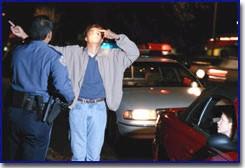
Sorry, no link for this, but this morning on the radio I heard some rather disturbing news. Legislators are planning to reintroduce a bill to help police stop underage drinking in Frederick County. Under current law, a police officer witnessing a minor in possession of an alcoholic beverage may arrest the minor for underage possession of alcohol. Additionally, an officer who witnesses a driving minor who appears to be under the influence of alcohol may arrest the same. The new law would allow an officer to detain a minor who simply appears to be acting as if under the influence of alcohol on suspicion of underage drinking. He could also force a breathalyzer test.
This bill was introduced last year and failed, as some opponents feared that this would grant too much power to the police. Well, of course it does! Most importantly, you're giving police the power to harass minors without evidence. Remember when Washington DC allowed DUI arrests based solely on the officer's judgement of intoxication? Before that law was finally changed, we saw numerous arrests and convictions for DUI of drivers with a
BAC under 0.04, and one arrest of a driver who blew a 0.00
BAC at the scene. Give Maryland troopers the same authority, and you'll get the same results.
No standards exist to define at what point an officer can stop a minor and force a breathalyzer test. If an eighteen year old is jogging through the park and sees an attractive young lady, he may weave slightly as he is distracted. Can he now be tested for his erratic jogging? This law would give police the authority to perform an unreasonable search and seizure on a minor without justification or evidence except the officer's judgement.
I'm also curious as to what the minor would be charged with. In the vast majority of states, including Maryland, the consumption of alcohol while under the age of 21 is not a crime. Purchase, possession, and consumption prior to driving are, but consumption is not. Why? Because the law specifically allows immediate family members to provide alcohol to minors within their own homes. If you can convince your parents that you're mature enough to drink, you are home free. And yes, I know a great number of parents that do purchase beer and wine for their children in Maryland.
So, in a nutshell, Bob the 18 year old kid is going to prom. He's hired a limo, so he isn't driving. His libertarian parents split a bottle of champagne with him first, to celebrate his "growing up." Walking into the prom, a police officer decides to perform a breathalyzer on him, and finds he blows a 0.02. What's the charge? Drunk and disorderly? I don't get it.

You've all heard the argument that if you're old enough to serve your country, you're old enough to drink. Ironically, the majority of people I meet who agree with that statement feel that anyone in the military should be allowed to drink, while civilians should have to wait until they are twenty-one. You could do three full tours in Iraq before your twenty-first birthday. If you were mature enough to make that decision at eighteen, you were sure as hell mature enough to make a decision on a glass of beer. Even if you decided the military wasn't for you, surely you've now reach the point in life where you're responsible for your own actions?
Look, folks, don't any of you remember being twenty? Try to remember the first time you drank alcohol. How old were you? Did you do it in your own house with your parents? In college, maybe in a frat house?
The absolute best place to learn about alcohol is from your own parents. Your parents are there to teach you about life. This is why most states allow parents to provide alcohol to their children. If you do not teach your children about drinking,
someone else will. Chances are that person will be a peer with no more experience that your kid. They're probably be influenced by movies showing severe intoxication. They'll probably purchase cheap flavorless beer and liquor, and consume it in great quantities.
I thank my parents for wisely introducing me to alcohol at an early age. Twelve, if you're counting. Of course, they closely monitored how much I drank, and I didn't even get a buzz on until I was sixteen. I was eighteen when I finally got drunk. Imagine that -- six years of experience appreciating alcohol before I first managed to get drunk.
The
neo-prohibitionists want to outlaw responsible parenting. They think by delaying the consumption of alcohol as long as possible, they can remove it entirely from our culture. It's simply not true. What we're getting is a nation of closet drinking youth, afraid of any supervision while they explore adulthood.
My message to America is "Teach your children well." My message to the government is "Get out of our way. We're better than you at this."
Labels: alcohol, dc, nanny state, personal freedoms
Mothers Against Drinking
 Mothers Against Drunk Driving
, or MADD, is out of control. Think they're only out there to stop drunk drivers? Not at all. Want to know MADD's official position on taxes?
MADD supports a prevention component to health care reform and supports a substantial increase in taxation on alcoholic beverages as a means of covering the cost to society caused by misuse of alcohol and as a means of supporting prevention programs including countermeasures to alcohol-impaired driving.
Okay, so they're tax & spend types, but other than that, they're OK, right? Hardly. Did you realize that MADD is lobbying for states to make Happy Hour illegal? Earlier closing hours in bars? How about some of their
proposed rules for alcohol advertisements, which state no advertising shall:
- Feature actors, models or other talent or characters under the age of 30
- Be broadcast to audiences with less than 90% adult aged 21 and older viewership
- Feature on-camera consumption
- Use celebrities, music stars, athletes, animals, cartoon characters, or other language or images that appeal to youth
- Depict sports, rock concerts, or other events with strong appeal to youth
- Depict revelry or hint at the possibility of inebriation
- Portray drinking in association with sexual passion, promiscuity, or any other amorous activity as a consequence of or in association with alcohol consumption
- Disproportionately target ethnic minority communities
So just to be clear, the worst possible thing in the world to MADD would be a television ad showing a black music star having a good time with a beer in his hand, while talking to his girlfriend. If it were up to MADD, all alcohol advertisements would be black text on a white screen, stating simply: Please buy our product, just don't drink it.
MADD has become a Neo-Prohibitionist organization. Even the founder of MADD is on the record as stating "It has become far more neo-prohibitionist than I had ever wanted or envisioned." Learn more at
Neoprohibition.com, and try reading their
excellent study on MADD. (PDF)
So what brings this rant on? The Texas Alcoholic Beverage Commission is
sending undercover officers into bars to look for drunk patrons, and issuing citations and making arrests. That's right, arresting people for being drunk in a bar! MADD is fully supportive of this campaign, with a spokesman saying "Can you imagine if TABC had not stopped those people from leaving the bar, how many more drunk drivers we might have had on the road?"
Earth to MADD -- the officers weren't stopping anyone from leaving the bar, they were stopping them in the bar. Some of those drunks may have been planning to call a cab, or had a designated driver. But MADD isn't about stopping drunk driving -- they're about stopping drinking.
For the record, Fairfax county tried this about a year ago. It was covered in the Washington Post as well as in the Neo-prohibition study linked above. Enforcement died after a Washington Post article about a designated driver (!) who was told she had to "prove" she was sober while in the bar. The article stirred up enough controversy to stop police from arresting folks in bars, at least temporarily.
Labels: alcohol, nanny state, personal freedoms
The Point Of Freedom Is To Deny It To Those You Hate

Has anyone been following the
Gay Marriage Ban that has been progressing through Virginia? It looks like it will be put before voters in a referendum in November. Just to clarify, Virginia already bans same-sex marriages; this bill is intended to prevent couples married in other states from having any legal status in Virginia.
Supporters say they aren't trying to discriminate against homosexuals, but rather preserve marriage. I don't understand that. I'm not homosexual, and I'm married. Were homosexuals allowed to be married, I don't see how my family would fall apart. Nothing would change for anyone, except homosexuals. Why should I be against them enjoying the same legal benefits that I enjoy?
Del. Kathy J. Byron (R-Lynchburg) is one of the amendments main drivers. Tell me, does this sound like someone who has a good handle on their own lifestyle choices: "Marriage is much more than just two people sharing a committed relationship. By changing the definition of marriage, the family, too, would be redefined, ultimately destroying the traditional family. And if the traditional structure of family no longer matters, what is marriage for?" She is assuming that allowing two women to marry will mean that no women will marry or raise families. Wrong, Kathy, some of us are pretty confident that the human race will survive if people are allowed to choose who they have sex with.
The main opposition, strangely enough, isn't coming from those who support gay marriages. The opposition is coming from legislators afraid that straight couples in non-traditional relationships may be impacted. They worry the bill, which disallows any rights to unmarried non-family members, would impact unmarried couples right to make health care decisions, and even reduce protection to unmarried victims of domestic violence.
What's wrong with this picture? Opponents of the bill are saying they like the general idea, but they worry that straight people might be affected? Is there no one left who believes that each American should be free to pursue his own happiness, in his own way, without government interference? When can we finally kick Uncle Sam out of our bedrooms?
Phinky made an
excellent point on
Ignorant Hussy. In the aptly-named
Loving v. Virginia, the United States Supreme Court struck down a
Virginia law prohibiting interracial couples who married in other states from living as husband and wife in Virginia. If I may quote from
the decision:
Marriage is one of the "basic civil rights of man," fundamental to our very existence and survival.... To deny this fundamental freedom on so unsupportable a basis as the racial classifications embodied in these statutes, classifications so directly subversive of the principle of equality at the heart of the Fourteenth Amendment, is surely to deprive all the State's citizens of liberty without due process of law. The Fourteenth Amendment requires that the freedom of choice to marry not be restricted by invidious racial discriminations. Under our Constitution, the freedom to marry, or not marry, a person of another race resides with the individual and cannot be infringed by the State.
If you don't see a relationship between this bit of history and the current debate, perhaps you should read up on the arguments used to support bans on interracial marriages in the last century.
Labels: homosexuality, personal freedoms
FBI Monitors US for Radiation
Faced with angry complaints, U.S. officials defended an anti-terrorism program yesterday that secretly tested radiation levels around the country... Angry complaints? Why would anyone be upset to learn that the FBI had been monitoring radiation levels, in order to detect any radioactive material that could be used in a dirty bomb?
Because among the list of sites monitored, which included airports, government buildings, businesses, and warehouses, were a number of mosques.
Virtually every attack carried out by Islamic terrorists can be traced to a mosque at some point. Why? Because they're
Islamic terrorists. If there were a serious danger of clowns detonating dirty bombs, I'd expect the FBI to start nosing around circuses, too.
An unnamed official who spoke to a reporter about it (
Washington Post article) said "now it sounds like a crazy thing. But at the time it didn't sound like a very crazy thing." Hey Jack, I don't think it's a crazy thing. The nice thing about detecting radiation is that it carries out from the source, so it can be detected at a distance, e.g., the street. And since radiation is in itself dangerous, the FBI has a legitimate interest in detecting it on public property, even if there's no reason to suspect a dirty bomb is being built. And since Usama bin Laden has declared that he wants to destroy America, and we know he's expressed interest in dirty bombs... I only have one question:
Why was this program stopped in 2003?
Labels: personal freedoms, privacy
Democrats Reject Free Speech

If you've been following campaign finance reform at all (and you should), then you probably know that the courts ruled public communications to include the Internet. This means that any speech on the Internet endorsing or disparaging a candidate or political party in an election would be considered regulated campaign contributions. In other words, every blogger in America who posted opinions on an election should add the cost of the endorsement (computer, blogging service, bandwidth, etc.) and count that as a campaign contribution. Campaigns should also track these contributions to ensure they don't exceed any limits.
I'm against Campaign Finance Reform in general. Every time I see it, its invariably a proposal to limit speech somehow. When the courts determined that the most recent law applied to the Internet, it had the effect of legally regulating speech by individuals so far as to effectively prohibit it.
HR Bill 1606 was introduced to plug that gap. Specifically, it states:
Paragraph (22) of section 301 of the Federal Election Campaign Act of 1971 (2 U.S.C. 431(22)) is amended by adding at the end the following new sentence: `Such term shall not include communications over the Internet.'.
A very simple bill that shouldn't generate any opposition, right? Representative Hensarling (TX-5) didn't think so, and he brought the bill to a vote on a motion to suspend the rules. This is typically done for bills that are so noncontroversial that normal procedures are pointless; instead a vote is brought out immediately. To prevent abuse, bills brought forward under this motion require a two-thirds majority to pass. Clear so far?
The bill didn't pass.
Click here for a XML breakout of who voted what, or
here for some basic analysis include a colored map of the nation. The vote was roughly along party lines, with 82% of Republicans voting Aye, and 24% of Democrats doing the same. Totals were 225 Aye, 182 Nay, 26 Not Voting. While that's a majority, it didn't meet the higher requirements brought forth by suspending the rules.
Representative Martha Blackburn has
some thoughts on why it didn't pass, and Matt Johnston has some more at
his blog. But both missed the underlying reason -- the majority of the liberal left oppose free speech. Rather than allowing a free discourse of ideas, they believe that Americans should be feed a healthy mixture of approved ideas. Let the public be educated by the government; don't let the public experiment with the government.
Don't believe it? Just look to California, where Gov. Schwarzenegger has put Proposition 75 up for a referendum on November 8th. This law, if passed, would prohibit unions of public employees from spending dues on contributions to political parties and candidates. A quick trip to the liberal
Alliance for a Better California will list many reasons why this bill is bad:
Supporters of Prop. 75 aren’t for workers rights. They’re using that argument as a smokescreen to push their real agenda. They’re against the minimum wage, against strengthening employee health care and against the eight-hour work day. And they support cuts to education, health care and oppose retirement security.
Nevermind that none of that is mentioned in the bill. The Alliance does post the real reason they oppose Proposition 75: "Prop. 75 is designed to reduce our ability to respond when politicians would harm education, health care and public safety, effectively clearing the opposition to the Governor’s education and health care cuts." It's not about education or health care cuts; those are scare tactics to motivate voters. It's the first phrase -- "Prop. 75 is designed to reduce our ability to respond..."
Yes, Proposition 75 forces the public to do the actual thinking and voting. Democrats prefer a system where the union forces the public to hand over cash in dues in order to keep their jobs. The union then distributes that money to political causes that it believes are right. What makes Proposition 75 such a good idea is that it specifically targets
public employees. Did you realize that many state government employees, as a condition of employment, must pay union dues -- and then watch as the union passes that money directly to the Democratic party?
The good news? Polls show a majority of Californians oppose Porposition 75. And HR 1606 is not dead. Now that it failed to bypass the rules, it can still be considered as a conventional bill. This is a stumbling block, but a minor one. With a majority of representatives in favor, it stands a very good chance of passing. Improve that chance by writing your representative and senator today! Also, check out
EFF's resources for bloggers, and blogging freedom.
Labels: free speech, personal freedoms
DC Bill Passes
Good news! The emergency legislation that I mentioned
here has passed. Unless the mayor vetoes it, you can no longer be charged with DUI regardless of your blood alcohol content. The new rules put DC in line with Maryland and Virginia. Namely:
| Under 0.05 | You are presumed not intoxicated |
| 0.05 - 0.079 | You are not presumed intoxicated. You may be charged if you exhibit other signs of intoxication, such as slurred speech, erratic driving, etc. |
| 0.08 and above | You are presumed intoxicated. |
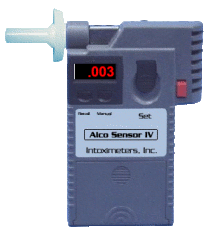
Not sure what these numbers mean? Run
this test to see how quickly your
own BAC rises.
I'll tell you now that my opinion is 0.08 is too low, and many drivers are able to drive perfectly well at that level of alcohol. However, let's celebrate one battle at a time. And I'd also like to thank all the Nervous Rodent readers who wrote or called their councilmen to help get this legislation through.
Mayor Anthony Williams has ten days to decide whether to veto the legislation. He's already attacked it, calling it "hastily written" and criticized the council. E-mail and call the mayor, explaining that it is necessary to keep DC businesses alive, and DC drivers safe from unfair prosecution.
Assuming the mayor doesn't stand in the way of this bill, it will take effect for ninety days. In that timeframe, new legislation will have to pass to make the changes permanent. Tell you councilmen that you don't think police should be able to charge drivers with crimes they can prove they didn't commit.
Voting against the measure: Kathy Patterson (D-Ward 3), Phil Mendelson (D-At Large) and Sharon Ambrose (D-Ward 6).
Check out
Paulie's post on this at
Paulie World.
Labels: alcohol, dc, nanny state, personal freedoms
This Week in Iraq

I made a prediction last week that the referendum would limit the starting of new projects in Iraq, and it looks like I was right. The big news, of course, is the referendum.
You've probably been reading the
blogs about the upcoming referendum. If you missed it, you'll definitely want to read
this one written by an Iraqi citizen, where he describes the Ba'athist propaganda, as well as compares this vote to those under Saddam.
But here's the
news: Out of 1,200 polling stations, only five were attacked. Nobody was killed, and only seven voters were injured. During last year's elections, I remember the editorials talking of violence, but the embedded reporters were just showing Iraqis dancing in the streets, holding their thumbs in the air. The terrorists were unable to stop that election, and they did even worse stopping this referendum.
Make no mistake, this referendum is important -- far more important than the elections. And whether they vote yes or no, it's still a good thing. The elections allow the Iraqi people to choose leaders, but the referendum allows them to choose a system of government.
Nervous Rodent's prediction: 65% yes, 10.5 million votes cast, constitution passes. We'll see how well I do.
But since you expect to hear things here that aren't printed elsewhere, I do have a little tidbit to tide you over. Thursday and Friday saw groundbreaking ceremonies for the construction of two new substation feeders, costing a total of $1.5 million, in Baghdad. And a new $200,000 clinic is opening in Baghdad. Next time you wonder why the US is spending so much on the "war" in Iraq, remember that much of the money is helping people help themselves.
Also,
Michael Yon has a new blog post up. While it may not be news events from Iraq, it is news from Iraq. And as always, he will help you see what life in Iraq is really like. This time he also helps show why the media is giving such a distorted view.
In other news, the DC Council has introduced
emergency legislation that states anyone driving with 0.05% BAC or below is presumed not intoxicated. Keep calling your councilmen, and let's make this thing pass!
Labels: alcohol, dc, iraq, nanny state, personal freedoms
Too Drunk to Drive, Continued

Remember this mug shot? You should, because I posted an
article about Police Chief Ramsey last week. I called on him to admit his mistakes and correct them. And now, as the Washington Post
continues its series about DUI laws in the District, I'd like to say it again.
Given my
previous article on DUI laws, and the controversy that the Washington Post has stirred up, you'd think that the Police Chief would set about to correcting the wrongs, right? Or would you expect him to lie, again, to the press? Let's examine the facts:
While being interviewed by the Washington Post, Officer Dennis Fair was quoted saying "If you get behind the wheel of a car with any measurable amount of alcohol, you will be dealt with in D.C. We have zero tolerance."
When the Post asked Ramsey about that quote, Ramsey replied "He's wrong if he's saying that. It's not coming from me, and that's certainly no policy I've instituted. That's just incorrect." Ramsey then denied that he has ever used the term "zero tolerance" to describe the DC policy on drinking and driving. Why then, Chief Ramsey, did the DC Police Department's website say that DC has a "zero tolerance" policy until Tuesday, the day that the Washington Post printed the first article in the series?
Don't believe me? Use the Web Archive to check the facts.
This link will take you to an archived copy of the DC Police's website from last week, and
this link will take you to the same webpage today.
That's twice in two weeks that Police Chief Ramsey has been caught in an outright lie. Folks, call your Councilman and demand that DC's laws on drinking and driving be brought in line with the rest of the nations. And Chief Ramsey, it's time for you to start telling the truth.
Labels: alcohol, dc, nanny state, personal freedoms
Too Drunk to Drive, Too Sober to Patrol
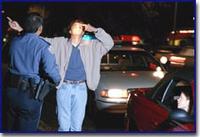
It's a well-intentioned law, I admit that. But DC's DUI laws are hurting innocent people, and it's time they were changed.
After the Washington Post ran an
article earlier this week about Debra Bolton's legal troubles, people are starting to
notice. And it's about time.
In most states, the legislature has set a legal limit for the maximum concentration of alcohol in the blood when driving, usually 0.08%. This is generally acknowledged as a simplistic solution to a complex problem. We all know someone who can drink way more than they ought to, and still act sober. We also know people that drink very little and still stagger about. What this means is that not everyone reacts the same way to the same concentration of alcohol.
To even things up, many states having two threshold levels. In Maryland, for example, driving with a blood alcohol content of 0.08% is illegal -- period. You will be charged with DUI in that case. If the BAC is between 0.07% and 0.08%, that is considered prima facie evidence of DWI, and you will probably be charged. Between 0.05% and 0.07%, you may be charged with DWI, if your other actions indicate that you not only ingested alcohol, but that you are impaired by it. Below 0.05%, you are not considered impaired by alcohol.
This system gives police a little leeway to evaluate drivers straddling the fuzzy line, where some might be perfectly safe, while others are clearly unable to safely drive. Of course, there are cases when police make poor decisions, but the law does limit the policeman's ability to make judgments that aren't backed by evidence. He couldn't declare someone with a 0.15% BAC to be sober, nor could he declare someone at 0.02% to be drunk.
Not so in Washington, DC, where the law gives the policeman all the latitude he needs to make judgment calls. Driving at 0.08% or higher is an automatic DUI charge, but a police officer may charge any individual with DUI, based solely on his judgment, regardless of blood alcohol levels. As a result, hundreds of people are charged each year with DUI or DWI, despite having blood alcohol levels of 0.03% or lower.
How low is 0.03%? An average woman who drinks a single glass of wine with dinner, over the course of an hour, will typically score about 0.03%. Ever seen a woman sip a single glass over an hour, then stagger down the street drunk? Me neither.
But some DC police go even further. This year they even charged a computer programmer who registered a perfect 0.00% on the scale, because in the officer's judgment, he was drunk.
The vast majority of these cases are dropped without conviction, generally for lack of evidence. But that doesn't mean they don't matter. It can cost thousands of dollars to contest a DUI charge. And being found innocent in court doesn't mean your insurance company will consider you innocent -- or even the DMV. According to Corey Buffo, the general counsel for the DC DMV,
"Our burden of proof is lower.... Not enough evidence for them may be enough evidence for us."
You you get pulled over on a bum charge, the officer decides he doesn't like you, and he charges you with DUI. You spend thousands of dollars to prove you're innocent, but your license is still suspended. When you finally get it reinstated, your insurance has doubled.
All those in favor of responsible legislation, raise your glasses. Unless you plan on driving home tonight.
Labels: alcohol, dc, nanny state, personal freedoms
Sins of the Court
Despite what you may hear during some of the confirmation hearings for Supreme Court justices, the Supreme Court has one real job. The Court should balance the powers of the Executive and Legislative branches of government, especially when it comes to violations of the Constitution. If someone violates your Constitutional rights, the Supreme Court is your final resort.
Unless, of course, you're a minority.
Which is rather hypocritical for a court that has "Equal Justice for All" emblazoned across the front of the building. But that's the way it is.
Yesterday, the Supreme Court
decided not to hear the case of
Cynthia Simpson, who had been denied the right to give an invocation for the Chesterfield County board meetings. She was denied the right because she is a Wiccan, and therefore not Christian.
Cynthia successfully sued on the basis that the county was giving preference to Christian clergy over other religions. However, the county appealed to the District Court after changing their policy to disallow the mention of "Jesus" during invocations, and the District Court
held that meant that the county was no longer giving one religion preference over another. Since the Supreme Court will not hear the case, the District Court's decision stands.
The county will accept invocations from Jewish, Muslim, and Christian clergy. No other religions are permitted to give invocations. While many may not see a problem with this, try role reversal. Imagine if over the next twenty years, most of the country converts to another religion. Now imagine you are a Christian, and a minority. Would you feel the same way if you were told that Christians could not give invocations at government functions, while other religions could?
Frankly, I don't think a government meeting is the right place for group prayer. If you're going to do it, you're going to have to let every religion do it. Banning all but three religions is nothing less than the establishment of three official religions, and as we all know,
Congress shall make no law respecting an establishment of religion, or prohibiting the free exercise thereof; or abridging the freedom of speech, or of the press; or the right of the people peaceably to assemble, and to petition the government for a redress of grievances.
Labels: church, personal freedoms
Free Speech vs. Fair Elections
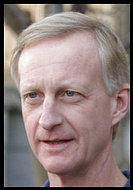
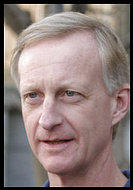
Councilman Jack Evans, shown to the right, is in
hot water. Maybe not as bad as
Marion Barry, who has been indicted for tax fraud, but hot water nonetheless. Apparently, Jack Evans has been running a Political Action Committee, and handling the money and reimbursements himself. In English, he has been accused of taking money from supporters, and spending it on his campaign.
Say what?
The
Federal Election Commission has developed rules to prevent rich corporate moguls from "buying" elections. These rules limit how much can be given as campaign contributions, and how much can be spent on TV ads and so forth.
Just to prove how effective those rules are, I challenge you to name a single candidate for president that garnered significant support, but was not a millionaire. I couldn't either. But I do remember Ross Perot, who tried to buy an election without a party behind him. Kerry had the Heinz fortune, and Bush is rich in the wealth of Texas oil. Even Cheney's got Halliburton backing him up.
The reasons that money still talks in politics are multiple. Firstly, would you vote for a man that was not capable of raising significant funds? If you've got the charisma, intelligence, and social aptitude to be the leader of the free world, you're not going to be flipping burgers at McDonalds at forty-five. Secondly, Political Action Committees (PAC's) can spend millions of dollars without being bound by the FEC's rules.
Over the last few elections, you've seen PAC's in action. As the FEC tightened rules elsewhere, PAC's grew in importance. Now it seems that PAC's, like
Swift Boat Veterans and
MoveOn are more vocal than the candidates. And that's because they are! As long as they don't endorse a specific candidate or break various other rules, they can spend all the "soft" money they want.
Most bloggers were completely unaware of campaign law until the Bipartisan Campaign Reform Act of 2002, known as the
McCain-Feingold Law, was
extended to apply to the Internet by US District Court Judge Colleen Kollar-Kotelly. Unable to register and comply with complex PAC regulations, bloggers who endorse candidates will be considered campaigners -- and subject to a candidate's limitations on campaigning. Fundamentally, this will
legally prevent bloggers from endorsing candidates at all, to include quoting or reprinting press releases or linking to campaign sites.
Congress shall make no law respecting an establishment of religion, or prohibiting the free exercise thereof; or abridging the freedom of speech, or of the press; or the right of the people peaceably to assemble, and to petition the government for a redress of grievances.
I think most people agree that money shouldn't buy elections. Major media conglomerates should not charge less for ads for candidates from one party than another. But our government has no right to prevent the public, or the press, from expressing our own opinions on candidates. Nor should our government restrict candidates from spending money to obtain airtime, in order to have their opinions heard by the public. Because while money may be the root of all evil, free speech is the foundation of a free society.
Labels: dc, free speech, personal freedoms
Nervous Rodent's Manifesto
 Last updated: 29 September 2005
I figure everyone has the right to know where a blogger is coming from, so I'm posting a manifesto of sorts. This isn't all-encompassing, but it should serve to give everyone an idea of where I'm coming from politically.
- The government that governs best, governs least. -- Thomas Jefferson
- Every service provided by the government is paid for out of the coffers of American wealth, e.g., taxes. To endorse spending is to postulate that the government can get more productivity from the wealth than private citizens, corporations, or organizations.
- It is not a crime that hurts none. All laws should exist to protect innocents; any law that does not is superfluous.
- The economy knows best. Only in the most extreme cases should the government interfere with the free working of the economy. Having said that, many problems are caused by government interference, and may require additional action to correct.
- All people have equal rights, and should be treated equally under the law. Giving privledges to one group over another to correct perceived "disadvantages" is insulting and degrading.
- It is better to fight for your country on foreign soil than at home. Like all rational people, I oppose war on principle. But I would rather fight in Iraq and Afghanistan than Maryland and Virginia.
- There is nothing wrong with religion. Except that no government should ever invoke it, for any reason. Government, by definition, has power over people, and the combination is dangerous in the extreme.
- All citizens have the right to argue and petition for change. Our Constitution has an amendment procedure for a reason. Violent action against a government is only justified against governments that do not, and it is especially justified in that situation.
- Debate and discourse of individuals is preferable to news and editorials dictated by major corporations.
- Opinions change, including mine. This manifesto may change with time. That's because I will, too.
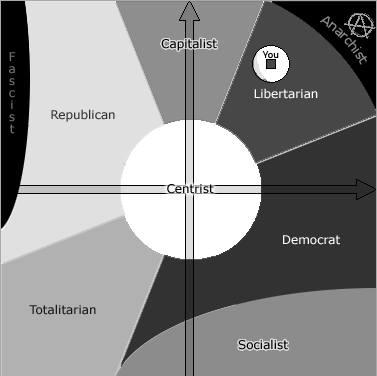
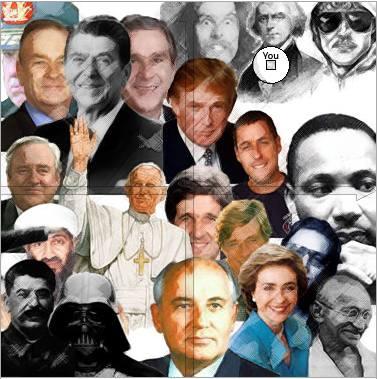
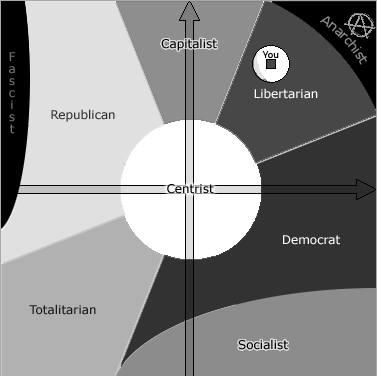
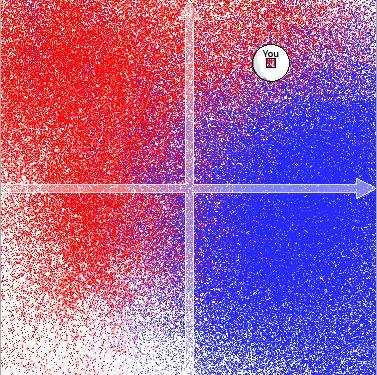
The images at the bottom give a bit of a clue. They are courtesy of the
OkCupid politics test. Feel free to take the test, and post your results as a comment so I can see what my readership is like. I'm 71% socially liberal, and 83% economically permissive. The first graph tells me I'm a Libertarian, the second tells me I'm similar to Jefferson, and the third tells me that people who scored similar results to me were split between Bush and Kerry in the last election.

Thanks to
Dave's Not Here for pointing me to this test.
Labels: afghanistan, church, iraq, nanny state, personal freedoms, privacy, racism, state's rights, taxes
Guilty Unless Proven Innocent
 This
This is truly disturbing news. I was surfing blogs and came across
this entry on
The New England Republican, which ought to bother the crap out of you.
Apparently, a twenty year veteran of the Marine Corps, and veteran of three foreign wars, was dismissed from his job as a police officer because seven years earlier an ex-girlfriend charged that he had harrassed her. No evidence was found to substantiate the claims, and he was never taken to trial.
I was going to take a day off from blogging, but this just sickens me. Having been falsely accused of crimes a couple of times in my life, and having spent a few days in court on the wrong side of the bench, I've got a lot of sympathy for those accused of crimes they didn't commit. While our legal courts may require evidence to convict a person, increasing the courts of public opinion do not. Just ask
Tom Delay, indicted on charges that I can't even fully comprehend. I'm not saying I like the guy, but I just can't quite figure out what was illegal. IANAL, but don't you have to show intent to intent to commit a crime in order to convict someone of conspiracy?
It's time to stop judging people prematurely. That, and I really wanted everyone to hear Dennis Walsh's story. These things need to be told.
Labels: heroes, nanny state, personal freedoms, privacy
Big Brother or Nanny?
Only one day before
Tom DeLay announced that eleven years of GOP domination of the house has finally won the war on wasteful government spending, the
FBI has opened a new account, and fitted it with blank checks.
After nearly two decades of fighting child pornography online, with only moderate success, the FBI has decided to expand the War on Pornography to include activities between consenting adults. Yes, consenting adults. We're not talking about child pornography or rape, we're talking about things normal people do in their own homes (and then gasp if they hear them mentioned in public). Get ready to gasp -- I'm going to say them here.
In a
Washington Post article last Tuesday, announcing the creation of a new task force to seek out obscene material, an FBI memo was quoted as saying the best odds of conviction come with pornography that "includes bestiality, urination, defecation, as well as sadistic and masochistic behavior."
Note to college kids: Your hardcore porn is OK, as long as it isn't too rough.This is crazy. The
Miller Test, used since 1973 to define obscenity, is already hopelessly outdated. It has three tests which a work must pass in order to be considered obscene:
- Whether the average person, applying contemporary community standards, would find that the work, taken as a whole, appeals to the prurient interest,
Community standards? In the past, this meant the Supreme Court had ruled that material legal in San Francisco might be illegal in Utah, under the same Federal law. Now, lacking a good definition of community, Internet users form communities online. Maybe a little S&M posted in alt.childrens.books will offend, but within the S&M community it won't.
- Whether the work depicts/describes, in a patently offensive way, sexual conduct specifically defined by applicable state law,
Yes,a Federal law defines material as illegal under Federal law only if the state agrees. Another useless piece of legislation in the Internet age.
- Whether the work, taken as a whole, lacks serious literary, artistic, political, or scientific value.
Do you really think that Federal judges, the likes of John Ashcroft, are the best judges of what is art and what is not? The FBI memo said that S&M could be prosecuted, just fifteen years after Robert Mapplethorpe received National Endowment for the Arts funding for homosexual S&M works, including the famous picture of himself inserting a bullwhip into his own ass, and a crucifix in a jar of urine.
Possession of obscene material is not a crime -- only the production or distribution of obscene material is illegal under current law.
Rob Zicari, owner of a porn company, successfully argued in the District Court in Pittsburgh that citizens had a Constitutional right to view obscene material, and by prohibiting the production and distribution of such material, the government is infringing on that right. The case is currently under appeal -- assuming he wins again, this task force is investigating "crimes" that break no laws.
This is insane, and a waste of money. And you can thank Congress for it. Congress began funding the obscenity initiative in fiscal 2005 and specified that the FBI must devote 10 agents to adult pornography. "All other field offices may investigate obscenity cases pursuant to this initiative if resources are available," the directive from headquarters said.
An unnamed FBI worker said it best:
"I guess this means we've won the war on terror," said one exasperated FBI agent, speaking on the condition of anonymity because poking fun at headquarters is not regarded as career-enhancing. "We must not need any more resources for espionage."
Labels: free speech, personal freedoms, privacy, state's rights
 Even before that bill was passed, however, the Justice Department had been publicly stating that they felt Internet gambling was illegal, and would prosecute those who engaged in it. How many more people would have wagered online if they didn't have the spectre of
 So what does this mean? Absolutely nothing. Don't think for a second our politicians are afraid online gambling will create social ills and injure children, as they claim. Many of the states with explicit online gambling bans are those states with the largest gambling industries, including Nevada (373 casinos), Washington (143 casinos), and Montana (136 casinos). This is a clear-cut case of big business, namely the American gambling industry, pushing politicians to restrict American's freedoms for the sole purpose of reducing competition and ensuring higher profits. The largest sponsors of the 2006 gambling ban? Casinos, with $28.5 million dollars spent in 2006 alone, or $53,271 for every Congressman in the House and Senate.