RIP COPA

In 1996, the
Communications Decency Act was passed, making it illegal to make obscene or indecent material available on the Internet where a minor could access it. The nascent Internet community reacted, with an
estimated five to ten percent of online websites switching to
black backgrounds (including
Yahoo!) for 48 hours, and a massive "blue ribbon campaign" that saw
blue ribbons on thousands of homepages for several months.
The law was never enforced, as a federal panel of judges enacted an injunction against it, and by the next year it had been overturned completely. A horrible law that died a quick clean death.
So, given Congress's penchant for attempting to pass an unconstitutional law by ramming it down the public's throat, the measure was pushed through Congress the following year (1998) under a new name, the
Child Online Protection Act (COPA). COPA limited the restrictions to commercial enterprises, but clarified the obscenity requirements to include all nudity, including female breasts. Medical health sites were among the many outraged by the new law, which would have required a credit card or other proof of age to access information on how to perform cancer self-exams.
The law was, once again, subject to an immediate injunction. The following year, the law was struck down. However, unlike the CDA, it was not quickly killed. The Attorney General chose to appeal the ruling, and by 2004 the Supreme Court reviewed the case and upheld the unjunction, but referred the case to a lower court for trial.
The Department of Justice then issued subpeonas to various Internet search engines for search records. All search engines complied except for Google, which
successfully fought the subpeona as illegal. The trial finally commenced, and this Thursday,
a verdict was reached. COPA is finally dead, having been found to facially violate both the First and Fifth Amendments to the Constitution. Senior U.S. District Judge Lowell Reed Jr. said in his ruling "[P]erhaps we do the minors of this country harm if First Amendment protections, which they will with age inherit fully, are chipped away in the name of their protection."
I have only two worries. The first is the inevitable third try Congress will attempt now that COPA is dead. The second is that this judge appears to think that you have to be eighteen to have free speech.
Labels: free speech, nanny state, personal freedoms
Global Online Freedom Act of 2007

Some bills are good ideas, and a great many are colossally bad ideas. Every now and then you get a bill that does a good thing the wrong way, and that's what the
Global Online Freedom Act of 2007 is. Introduced by Rep Christopher Smith (R-NJ) as a rework of the failed 2006 version, the bill is
currently sitting in the House Energy and Commerce Committee as well as the House Foreign Affairs Committee.
So what's all this about then? Here's a short history on the why of this bill:
- In 2005, Yahoo! provided information on a Chinese journalist who released an internal Communist Party message anonymously via the Internet, leading to his arrest and 10 year prison sentence.
- On Dec 31st of the same year, Microsoft removed a blog of a Chinese journalist. Microsoft had earlier that year admitted to censoring words like "freedom" and "democracy" from its Internet portal.
- Early last year, Google admitted that it censored search results for users in China.
What do all three events have in common? In all three cases, the companies stated they were simply complying with Chinese law, and had no choice.
In February 2006, the House held a
hearing in with Representative Tom
Lantos said "Your abhorrent activities in China are a disgrace. I simply do not understand how your corporate leadership sleeps at night."
It should come as no surprise to anyone that I abhor the thought of China censoring the Internet, and it sickens me that American companies are profiting from helping China through pro-democracy activists in the Gulag. But about this bill? Does the ends justify the means? Is the cost worth the result? I don't see a problem with Congress regulating international commerce, that is, prohibiting U.S. corporations from performing certain acts on behalf of foreign governments. There are three basic elements of the bill that bother me:
- The price tag of $50 million per year. What the heck is going to cost fifty million dollars per year? How hard is it to tell which countries are censoring the Internet?
- The massive reporting requirements. Anyone who removes any content from any server on behalf of a foreign government is basically required to describe the circumstances behind the removal to the State Department. Perhaps the $50 million is to pay for federal workers to read all these reports, but who's going to pay for the guys who waste time writing them?
- Export license restrictions. The bill tasks the Secretary of State to perform a feasibility study on restricting export licenses for products that facilitate restrictions on Internet freedom. Almost all networking technology can censor in some fashion, whether operating system, firewall, or router. Could this snowball into a situation like we had in the 90's where all decent cryptology was prohibited from export, holding computer security back for years?
My mind isn't made up quite yet. I offer this post primarily as food for thought. Chew deeply, unless you're in China, in which case you won't be able to find this blog that talks about democracy and freedom.
Ironically,
China denies censoring the Internet at all. Not that anyone believes them. Maybe the Chinese do. After all, if you search Google News from within China, I bet you won't find any evidence of censorship.
Labels: China, free speech, personal freedoms, privacy
Democrats Reject Free Speech

If you've been following campaign finance reform at all (and you should), then you probably know that the courts ruled public communications to include the Internet. This means that any speech on the Internet endorsing or disparaging a candidate or political party in an election would be considered regulated campaign contributions. In other words, every blogger in America who posted opinions on an election should add the cost of the endorsement (computer, blogging service, bandwidth, etc.) and count that as a campaign contribution. Campaigns should also track these contributions to ensure they don't exceed any limits.
I'm against Campaign Finance Reform in general. Every time I see it, its invariably a proposal to limit speech somehow. When the courts determined that the most recent law applied to the Internet, it had the effect of legally regulating speech by individuals so far as to effectively prohibit it.
HR Bill 1606 was introduced to plug that gap. Specifically, it states:
Paragraph (22) of section 301 of the Federal Election Campaign Act of 1971 (2 U.S.C. 431(22)) is amended by adding at the end the following new sentence: `Such term shall not include communications over the Internet.'.
A very simple bill that shouldn't generate any opposition, right? Representative Hensarling (TX-5) didn't think so, and he brought the bill to a vote on a motion to suspend the rules. This is typically done for bills that are so noncontroversial that normal procedures are pointless; instead a vote is brought out immediately. To prevent abuse, bills brought forward under this motion require a two-thirds majority to pass. Clear so far?
The bill didn't pass.
Click here for a XML breakout of who voted what, or
here for some basic analysis include a colored map of the nation. The vote was roughly along party lines, with 82% of Republicans voting Aye, and 24% of Democrats doing the same. Totals were 225 Aye, 182 Nay, 26 Not Voting. While that's a majority, it didn't meet the higher requirements brought forth by suspending the rules.
Representative Martha Blackburn has
some thoughts on why it didn't pass, and Matt Johnston has some more at
his blog. But both missed the underlying reason -- the majority of the liberal left oppose free speech. Rather than allowing a free discourse of ideas, they believe that Americans should be feed a healthy mixture of approved ideas. Let the public be educated by the government; don't let the public experiment with the government.
Don't believe it? Just look to California, where Gov. Schwarzenegger has put Proposition 75 up for a referendum on November 8th. This law, if passed, would prohibit unions of public employees from spending dues on contributions to political parties and candidates. A quick trip to the liberal
Alliance for a Better California will list many reasons why this bill is bad:
Supporters of Prop. 75 aren’t for workers rights. They’re using that argument as a smokescreen to push their real agenda. They’re against the minimum wage, against strengthening employee health care and against the eight-hour work day. And they support cuts to education, health care and oppose retirement security.
Nevermind that none of that is mentioned in the bill. The Alliance does post the real reason they oppose Proposition 75: "Prop. 75 is designed to reduce our ability to respond when politicians would harm education, health care and public safety, effectively clearing the opposition to the Governor’s education and health care cuts." It's not about education or health care cuts; those are scare tactics to motivate voters. It's the first phrase -- "Prop. 75 is designed to reduce our ability to respond..."
Yes, Proposition 75 forces the public to do the actual thinking and voting. Democrats prefer a system where the union forces the public to hand over cash in dues in order to keep their jobs. The union then distributes that money to political causes that it believes are right. What makes Proposition 75 such a good idea is that it specifically targets
public employees. Did you realize that many state government employees, as a condition of employment, must pay union dues -- and then watch as the union passes that money directly to the Democratic party?
The good news? Polls show a majority of Californians oppose Porposition 75. And HR 1606 is not dead. Now that it failed to bypass the rules, it can still be considered as a conventional bill. This is a stumbling block, but a minor one. With a majority of representatives in favor, it stands a very good chance of passing. Improve that chance by writing your representative and senator today! Also, check out
EFF's resources for bloggers, and blogging freedom.
Labels: free speech, personal freedoms
Free Speech vs. Fair Elections

Councilman Jack Evans, shown to the right, is in
hot water. Maybe not as bad as
Marion Barry, who has been indicted for tax fraud, but hot water nonetheless. Apparently, Jack Evans has been running a Political Action Committee, and handling the money and reimbursements himself. In English, he has been accused of taking money from supporters, and spending it on his campaign.
Say what?
The
Federal Election Commission has developed rules to prevent rich corporate moguls from "buying" elections. These rules limit how much can be given as campaign contributions, and how much can be spent on TV ads and so forth.
Just to prove how effective those rules are, I challenge you to name a single candidate for president that garnered significant support, but was not a millionaire. I couldn't either. But I do remember Ross Perot, who tried to buy an election without a party behind him. Kerry had the Heinz fortune, and Bush is rich in the wealth of Texas oil. Even Cheney's got Halliburton backing him up.
The reasons that money still talks in politics are multiple. Firstly, would you vote for a man that was not capable of raising significant funds? If you've got the charisma, intelligence, and social aptitude to be the leader of the free world, you're not going to be flipping burgers at McDonalds at forty-five. Secondly, Political Action Committees (PAC's) can spend millions of dollars without being bound by the FEC's rules.
Over the last few elections, you've seen PAC's in action. As the FEC tightened rules elsewhere, PAC's grew in importance. Now it seems that PAC's, like
Swift Boat Veterans and
MoveOn are more vocal than the candidates. And that's because they are! As long as they don't endorse a specific candidate or break various other rules, they can spend all the "soft" money they want.
Most bloggers were completely unaware of campaign law until the Bipartisan Campaign Reform Act of 2002, known as the
McCain-Feingold Law, was
extended to apply to the Internet by US District Court Judge Colleen Kollar-Kotelly. Unable to register and comply with complex PAC regulations, bloggers who endorse candidates will be considered campaigners -- and subject to a candidate's limitations on campaigning. Fundamentally, this will
legally prevent bloggers from endorsing candidates at all, to include quoting or reprinting press releases or linking to campaign sites.
Congress shall make no law respecting an establishment of religion, or prohibiting the free exercise thereof; or abridging the freedom of speech, or of the press; or the right of the people peaceably to assemble, and to petition the government for a redress of grievances.
I think most people agree that money shouldn't buy elections. Major media conglomerates should not charge less for ads for candidates from one party than another. But our government has no right to prevent the public, or the press, from expressing our own opinions on candidates. Nor should our government restrict candidates from spending money to obtain airtime, in order to have their opinions heard by the public. Because while money may be the root of all evil, free speech is the foundation of a free society.
Labels: dc, free speech, personal freedoms
Bring Your Bible To School!

In the sweltering summer of 1925, in Dayton Tennessee, the State
brought forth and prosecuted one Mr. John Scopes, a high school biology teacher accused of teaching evolution in the classroom. Be still my beating heart!
For those who forgot that two hour trial, John Scopes was convicted and fined one hundred dollars, later overturned on a technicality (the fine exceeded the amount allowable by law). John Scopes said, after hearing the sentence,
"Your Honor, I feel that I have been convicted of violating an unjust statute. I will continue in the future, as I have in the past, to oppose this law in any way I can. Any other action would be in violation of my ideal of academic freedom, that is, to teach the truth as guaranteed in our Constitution of personal and religious freedom. I think the fine is unjust."
Thirty seven years later, the law forbidding the teaching evolution in Tennessee was finally struck down as a violation of the First Amendment's Establishment Clause. The same year, John Scopes published a book,
Center of the Storm, in which he said: "The day will come when we will not be bothered by Fundamentalists."
Friends, that day is not today.
Nor is the current legal challenge in the backwaters of Tennessee. Today, this battle is being fought in Harrisburg, Pennsylvania. The state capital, and only two hours from Washington, DC, this
well-developed city boasts an International Airport, a well-esteemed minor league baseball team, and has been twice-honored as "All America City"(according to the National Civic League) -- and is now offering ringside seats to
The Monkey Trial II.
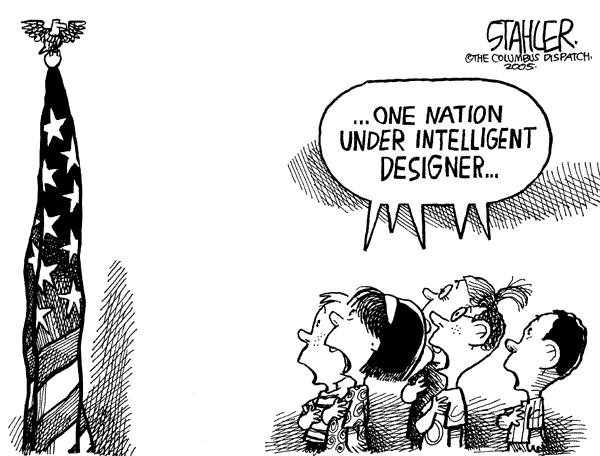
Eight families in the Dover Area School District are taking the school to federal court, arguing that the government has no right to teach their children "Intelligent Design," or the belief that evolution is bunk and God created everything.
Congress shall make no law respecting an establishment of religion. That wasn't so hard, was it?
Oh, but it is hard. As recently as 1987, the Supreme Court ruled that States cannot require schools to teach creationism. Yet even our President, George W. Bush,
has stated that schools should teach it. What's the deal here?
It's simple, folks. Teach your kids about religion at home, in church, and in your community. Don't ask the government to do it for you. Don't give me any crap about Intelligent Design not being religious -- it's the belief that a deity created the universe. That's a religion to me. Don't give me crap that it's "all religions," and therefore not in violation of the First Amendment. It clearly violates polytheistic beliefs, atheist beliefs, and the beliefs of many other religions that believe that while god(s) exist, they did not create the universe.
Maybe we should look at this from another point of view. Do you trust your government? Do you trust them enough to want them to teach your children about God?
I didn't think so.
9/27 - Update --
ScrappleFace is now covering this topic. Good to see a little light on the topic.
Labels: church, free speech, intelligent design
Big Brother or Nanny?
Only one day before
Tom DeLay announced that eleven years of GOP domination of the house has finally won the war on wasteful government spending, the
FBI has opened a new account, and fitted it with blank checks.
After nearly two decades of fighting child pornography online, with only moderate success, the FBI has decided to expand the War on Pornography to include activities between consenting adults. Yes, consenting adults. We're not talking about child pornography or rape, we're talking about things normal people do in their own homes (and then gasp if they hear them mentioned in public). Get ready to gasp -- I'm going to say them here.
In a
Washington Post article last Tuesday, announcing the creation of a new task force to seek out obscene material, an FBI memo was quoted as saying the best odds of conviction come with pornography that "includes bestiality, urination, defecation, as well as sadistic and masochistic behavior."
Note to college kids: Your hardcore porn is OK, as long as it isn't too rough.This is crazy. The
Miller Test, used since 1973 to define obscenity, is already hopelessly outdated. It has three tests which a work must pass in order to be considered obscene:
- Whether the average person, applying contemporary community standards, would find that the work, taken as a whole, appeals to the prurient interest,
Community standards? In the past, this meant the Supreme Court had ruled that material legal in San Francisco might be illegal in Utah, under the same Federal law. Now, lacking a good definition of community, Internet users form communities online. Maybe a little S&M posted in alt.childrens.books will offend, but within the S&M community it won't.
- Whether the work depicts/describes, in a patently offensive way, sexual conduct specifically defined by applicable state law,
Yes,a Federal law defines material as illegal under Federal law only if the state agrees. Another useless piece of legislation in the Internet age.
- Whether the work, taken as a whole, lacks serious literary, artistic, political, or scientific value.
Do you really think that Federal judges, the likes of John Ashcroft, are the best judges of what is art and what is not? The FBI memo said that S&M could be prosecuted, just fifteen years after Robert Mapplethorpe received National Endowment for the Arts funding for homosexual S&M works, including the famous picture of himself inserting a bullwhip into his own ass, and a crucifix in a jar of urine.
Possession of obscene material is not a crime -- only the production or distribution of obscene material is illegal under current law.
Rob Zicari, owner of a porn company, successfully argued in the District Court in Pittsburgh that citizens had a Constitutional right to view obscene material, and by prohibiting the production and distribution of such material, the government is infringing on that right. The case is currently under appeal -- assuming he wins again, this task force is investigating "crimes" that break no laws.
This is insane, and a waste of money. And you can thank Congress for it. Congress began funding the obscenity initiative in fiscal 2005 and specified that the FBI must devote 10 agents to adult pornography. "All other field offices may investigate obscenity cases pursuant to this initiative if resources are available," the directive from headquarters said.
An unnamed FBI worker said it best:
"I guess this means we've won the war on terror," said one exasperated FBI agent, speaking on the condition of anonymity because poking fun at headquarters is not regarded as career-enhancing. "We must not need any more resources for espionage."
Labels: free speech, personal freedoms, privacy, state's rights
 In 1996, the Communications Decency Act was passed, making it illegal to make obscene or indecent material available on the Internet where a minor could access it. The nascent Internet community reacted, with an estimated five to ten percent of online websites switching to black backgrounds (including Yahoo!) for 48 hours, and a massive "blue ribbon campaign" that saw blue ribbons on thousands of homepages for several months.



 Fresh political views and news from a Jeffersonian point of view, featuring both domestic politics and news from the war. For a good look at my political views, read my


