Global Online Freedom Act of 2007

Some bills are good ideas, and a great many are colossally bad ideas. Every now and then you get a bill that does a good thing the wrong way, and that's what the
Global Online Freedom Act of 2007 is. Introduced by Rep Christopher Smith (R-NJ) as a rework of the failed 2006 version, the bill is
currently sitting in the House Energy and Commerce Committee as well as the House Foreign Affairs Committee.
So what's all this about then? Here's a short history on the why of this bill:
- In 2005, Yahoo! provided information on a Chinese journalist who released an internal Communist Party message anonymously via the Internet, leading to his arrest and 10 year prison sentence.
- On Dec 31st of the same year, Microsoft removed a blog of a Chinese journalist. Microsoft had earlier that year admitted to censoring words like "freedom" and "democracy" from its Internet portal.
- Early last year, Google admitted that it censored search results for users in China.
What do all three events have in common? In all three cases, the companies stated they were simply complying with Chinese law, and had no choice.
In February 2006, the House held a
hearing in with Representative Tom
Lantos said "Your abhorrent activities in China are a disgrace. I simply do not understand how your corporate leadership sleeps at night."
It should come as no surprise to anyone that I abhor the thought of China censoring the Internet, and it sickens me that American companies are profiting from helping China through pro-democracy activists in the Gulag. But about this bill? Does the ends justify the means? Is the cost worth the result? I don't see a problem with Congress regulating international commerce, that is, prohibiting U.S. corporations from performing certain acts on behalf of foreign governments. There are three basic elements of the bill that bother me:
- The price tag of $50 million per year. What the heck is going to cost fifty million dollars per year? How hard is it to tell which countries are censoring the Internet?
- The massive reporting requirements. Anyone who removes any content from any server on behalf of a foreign government is basically required to describe the circumstances behind the removal to the State Department. Perhaps the $50 million is to pay for federal workers to read all these reports, but who's going to pay for the guys who waste time writing them?
- Export license restrictions. The bill tasks the Secretary of State to perform a feasibility study on restricting export licenses for products that facilitate restrictions on Internet freedom. Almost all networking technology can censor in some fashion, whether operating system, firewall, or router. Could this snowball into a situation like we had in the 90's where all decent cryptology was prohibited from export, holding computer security back for years?
My mind isn't made up quite yet. I offer this post primarily as food for thought. Chew deeply, unless you're in China, in which case you won't be able to find this blog that talks about democracy and freedom.
Ironically,
China denies censoring the Internet at all. Not that anyone believes them. Maybe the Chinese do. After all, if you search Google News from within China, I bet you won't find any evidence of censorship.
Labels: China, free speech, personal freedoms, privacy
We're Watching You!

I am now officially sick and tired of calls from Congressional leaders, non-profit groups, and mud-slinging politicians to investigate "President Bush's domestic spying program." Completely and utterly sick. So I'm going to set a few facts straight right here and now.
Firstly, next time a "key Congressional leader" protests this program, remember that all key Congressional leaders were repeatedly briefed on the specifics of the program. Anyone who claims they didn't know about it is either a lying bastard or just plain Ollie Northing the issue.
Secondly, previous Presidents, to include former President Clinton, have used the authority to initiate intelligence collection against entities within the United States without a court order. So when you hear Hillary spouting that it's illegal, keep that in mind.
Thirdly, it's not illegal. You may hear that the "wiretaps" were not in compliance with the
Foreign Intelligence Surveillance Act (FISA). Yes. However, this post isn't in compliance with that Act either, and it's legal. That law doesn't apply in this case -- that doesn't mean the activity is illegal. This program has been approved by the Department of Justice, the Attorney General as well as literally hundreds of lawyers in various government agencies, and subjected to a review every ninety days to ensure that it has remained in compliance with the law.
Even the Democrats admit that no law was broken, even as they bash President Bush for not staying within the confines of FISA.
Lastly, and most importantly, the program in question is
not "domestic spying." Domestic communications are defined as communications originating and terminating within the United States. This is the same definition of domestic used for domestic flights, domestic mail, domestic commerce, etc. Domestic communications require a court order to be intercepted and analyzed.
The program in question allows the National Security Agency to intercept communications of a known terrorist, not within the United States, even if the terrorist contacts a person located within the boundaries of the United States. Under rules in effect prior to September 11th, if a known terrorist in Afghanistan placed a phone call to New York, the NSA
could not intercept and process the phone call. The program in question does nothing more than to correct that.
This national security vulnerability was pointed out by the
9/11 Commission. They specifically criticized the intelligence community for not linking events in the United States to events overseas. What could possibly be more important to analyze than a phone call between a known terrorist and a person located within our borders? Yet prior to 9/11, such phone calls were "protected."
General Hayden was the director of the NSA when the program was established, and has since moved on to become the Deputy Director of National Intelligence. He spoke recently about this program, and I strongly urge everyone to read
his speech. There is no one who knows this program better than General Hayden. For those who won't follow the link, I'll quote a few choice sections:
NSA has an existential problem. In order to protect American lives and liberties, it has to be two things: powerful in its capabilities, and secretive in its methods. And we exist in a political culture that distrusts two things most of all: power and secrecy.... Look, this is not unlike things that happened in other areas. Prior to September 11th, airline passengers were screened in one way. After September 11th, we changed how we screen passengers. In the same way, okay, although prior to September 11th certain communications weren't considered valuable intelligence, it became immediately clear after September 11th that intercepting and reporting these same communications were in fact critical to defending the homeland. Now let me make this point. These decisions were easily within my authorities as the director of NSA under and executive order; known as Executive Order 12333, that was signed in 1981, an executive order that has governed NSA for nearly a quarter century.... I testified in open session to the House Intel Committee in April of the year 2000. At the time, I created some looks of disbelief when I said that if Osama bin Laden crossed the bridge from Niagara Falls, Ontario to Niagara Falls, New York, there were provisions of U.S. law that would kick in, offer him protections and affect how NSA could now cover him. At the time, I was just using this as some of sort of stark hypothetical; 17 months later, this is about life and death.... You know, the 9/11 commission criticized our ability to link things happening in the United States with things that were happening elsewhere. In that light, there are no communications more important to the safety of this country than those affiliated with al Qaeda with one end in the United States. The president's authorization allows us to track this kind of call more comprehensively and more efficiently. The trigger is quicker and a bit softer than it is for a FISA warrant, but the intrusion into privacy is also limited: only international calls and only those we have a reasonable basis to believe involve al Qaeda or one of its affiliates.... Let me talk for a few minutes also about what this program is not. It is not a driftnet over Dearborn or Lackawanna or Freemont grabbing conversations that we then sort out by these alleged keyword searches or data-mining tools or other devices that so-called experts keep talking about.... So let me make this clear. When you're talking to your daughter at state college, this program cannot intercept your conversations. And when she takes a semester abroad to complete her Arabic studies, this program will not intercept your communications.... Had this program been in effect prior to 9/11, it is my professional judgment that we would have detected some of the 9/11 al Qaeda operatives in the United States, and we would have identified them as such....
Labels: domestic spying, nsa, privacy
FBI Monitors US for Radiation
Faced with angry complaints, U.S. officials defended an anti-terrorism program yesterday that secretly tested radiation levels around the country... Angry complaints? Why would anyone be upset to learn that the FBI had been monitoring radiation levels, in order to detect any radioactive material that could be used in a dirty bomb?
Because among the list of sites monitored, which included airports, government buildings, businesses, and warehouses, were a number of mosques.
Virtually every attack carried out by Islamic terrorists can be traced to a mosque at some point. Why? Because they're
Islamic terrorists. If there were a serious danger of clowns detonating dirty bombs, I'd expect the FBI to start nosing around circuses, too.
An unnamed official who spoke to a reporter about it (
Washington Post article) said "now it sounds like a crazy thing. But at the time it didn't sound like a very crazy thing." Hey Jack, I don't think it's a crazy thing. The nice thing about detecting radiation is that it carries out from the source, so it can be detected at a distance, e.g., the street. And since radiation is in itself dangerous, the FBI has a legitimate interest in detecting it on public property, even if there's no reason to suspect a dirty bomb is being built. And since Usama bin Laden has declared that he wants to destroy America, and we know he's expressed interest in dirty bombs... I only have one question:
Why was this program stopped in 2003?
Labels: personal freedoms, privacy
Your Safety for Sale
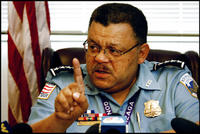
Folks, if you don't live in Washington, DC, you may not recognize the man to my left. His name is Charles Ramsey, and he's the Police Chief here in town. And he's a lying crook.
Despite today's
Washington Post article which revealed the District's red-light cameras have not had any effect whatsoever on accident rates, Chief Ramsey stands by them as effective. He says that the number of red lights being run has dropped by sixty percent since the cameras were installed in 1999. "They make people slow down. They reduce the number of traffic violations, and that's a good thing."
Okay, Chief. One question -- sixty percent fewer people run lights, but accident rates remain constant, what does that tell us? It tells us the people running red lights aren't causing the accidents. Second question -- why should the police department waste resources enforcing a traffic law that doesn't cause accidents?
Did I just say "waste resources"? These cameras don't waste resources. In fact, since installation in 1999, the forty-five cameras have netted the District a cool $32 million. If these cameras were meant to prevent accidents, not raise money, then why were seven installed at intersections that had not seen a single crash in years?
This isn't a new issue. In 2002, the Weekly Standard ran a
five-part serial about this. One of the surprising things they exposed was how this program was managed. The entire process was contracted to Lockheed Martin IMS, who kept $32.50 for every red-light ticket, and $29 for every automated speeding ticket. (Since then, the contract moved to Affiliated Computer Services.)
What's wrong with this picture? Not only does the program not serve a public purpose, but it also allows fines to be levied and points issued without the review of a government official. Pretty scary, since over a quarter of citations issued are successfully contested in court as misidentifications. It becomes worse when you realize the contractor has a financial incentive to ticket as many drivers as possible.
If you want to stop people from running red lights, increase the length of the yellow. They're way too short in Washington, DC -- and the government knows it. The average yellow at an intersection with a camera is four seconds, even though Federal guidelines suggest six seconds. None of the forty-five targeted intersections have seen yellow length increases to attempt to save lives. Of course, increasing the length of the yellow would decrease violations, and thus decrease revenues.
What about the speeding cameras? Surely those are helping us be safe, right? Wrong again! Repeated studies have shown that people generally ignore posted speed limits, and drive what they feel is a safe speed for the road. A Federal Highway Administration study found that changing speed limits by 15 mph caused drivers to shift speed an average of 1 to 2 mph.
People drive with the flow of traffic. A police officer in the median tends to slow the flow, at least temporarily. A hidden camera doesn't affect speeds at all, but it does issue citations to drivers that would risk being rear-ended if they drove the speed limit. How many drivers? In the first week of the Districts use of speed cameras three years ago, the police caught close to 10,000 drivers speeding. That's four percent of DC's population, and equal to the number of speeding tickets issued the prior year.
The net result is roads that are less safe, thanks to this hidden tax on drivers. But it's not just our roads that are less safe -- the Washington Times once reported that the large number of automated speeding tickets issued to fire trucks and ambulances had increased the average response time to a 911 call.
Folks, this is insane. There comes a point in the inevitable growth of any bureaucracy where its primary function becomes to grow larger. At this point, the District Police is more concerned with increasing revenues and expanding the government than protecting citizens.
Chief Ramsey, three years ago you said "It isn't about revenue making. It's about saving lives." With thirty two million dollars in revenue, and no lives saved, it's time to admit you were wrong.
Click
here for more links on red light cameras, and
here for a large collection of studies about this.
Labels: dc, nanny state, privacy
Nervous Rodent's Manifesto
 Last updated: 29 September 2005
I figure everyone has the right to know where a blogger is coming from, so I'm posting a manifesto of sorts. This isn't all-encompassing, but it should serve to give everyone an idea of where I'm coming from politically.
- The government that governs best, governs least. -- Thomas Jefferson
- Every service provided by the government is paid for out of the coffers of American wealth, e.g., taxes. To endorse spending is to postulate that the government can get more productivity from the wealth than private citizens, corporations, or organizations.
- It is not a crime that hurts none. All laws should exist to protect innocents; any law that does not is superfluous.
- The economy knows best. Only in the most extreme cases should the government interfere with the free working of the economy. Having said that, many problems are caused by government interference, and may require additional action to correct.
- All people have equal rights, and should be treated equally under the law. Giving privledges to one group over another to correct perceived "disadvantages" is insulting and degrading.
- It is better to fight for your country on foreign soil than at home. Like all rational people, I oppose war on principle. But I would rather fight in Iraq and Afghanistan than Maryland and Virginia.
- There is nothing wrong with religion. Except that no government should ever invoke it, for any reason. Government, by definition, has power over people, and the combination is dangerous in the extreme.
- All citizens have the right to argue and petition for change. Our Constitution has an amendment procedure for a reason. Violent action against a government is only justified against governments that do not, and it is especially justified in that situation.
- Debate and discourse of individuals is preferable to news and editorials dictated by major corporations.
- Opinions change, including mine. This manifesto may change with time. That's because I will, too.
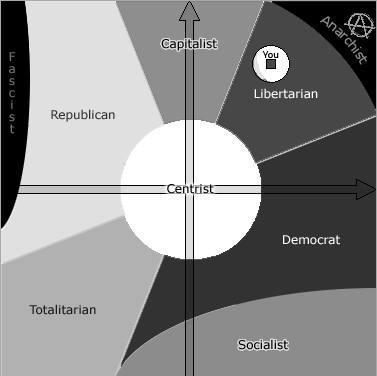
The images at the bottom give a bit of a clue. They are courtesy of the
OkCupid politics test. Feel free to take the test, and post your results as a comment so I can see what my readership is like. I'm 71% socially liberal, and 83% economically permissive. The first graph tells me I'm a Libertarian, the second tells me I'm similar to Jefferson, and the third tells me that people who scored similar results to me were split between Bush and Kerry in the last election.

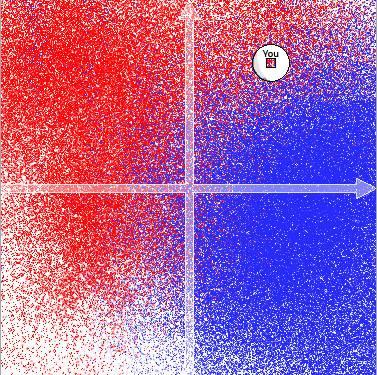
Thanks to
Dave's Not Here for pointing me to this test.
Labels: afghanistan, church, iraq, nanny state, personal freedoms, privacy, racism, state's rights, taxes
Guilty Unless Proven Innocent
 This
is truly disturbing news. I was surfing blogs and came across
this entry on
The New England Republican, which ought to bother the crap out of you.
Apparently, a twenty year veteran of the Marine Corps, and veteran of three foreign wars, was dismissed from his job as a police officer because seven years earlier an ex-girlfriend charged that he had harrassed her. No evidence was found to substantiate the claims, and he was never taken to trial.
I was going to take a day off from blogging, but this just sickens me. Having been falsely accused of crimes a couple of times in my life, and having spent a few days in court on the wrong side of the bench, I've got a lot of sympathy for those accused of crimes they didn't commit. While our legal courts may require evidence to convict a person, increasing the courts of public opinion do not. Just ask
Tom Delay, indicted on charges that I can't even fully comprehend. I'm not saying I like the guy, but I just can't quite figure out what was illegal. IANAL, but don't you have to show intent to intent to commit a crime in order to convict someone of conspiracy?
It's time to stop judging people prematurely. That, and I really wanted everyone to hear Dennis Walsh's story. These things need to be told.
Labels: heroes, nanny state, personal freedoms, privacy
Big Brother or Nanny?
Only one day before
Tom DeLay announced that eleven years of GOP domination of the house has finally won the war on wasteful government spending, the
FBI has opened a new account, and fitted it with blank checks.
After nearly two decades of fighting child pornography online, with only moderate success, the FBI has decided to expand the War on Pornography to include activities between consenting adults. Yes, consenting adults. We're not talking about child pornography or rape, we're talking about things normal people do in their own homes (and then gasp if they hear them mentioned in public). Get ready to gasp -- I'm going to say them here.
In a
Washington Post article last Tuesday, announcing the creation of a new task force to seek out obscene material, an FBI memo was quoted as saying the best odds of conviction come with pornography that "includes bestiality, urination, defecation, as well as sadistic and masochistic behavior."
Note to college kids: Your hardcore porn is OK, as long as it isn't too rough.This is crazy. The
Miller Test, used since 1973 to define obscenity, is already hopelessly outdated. It has three tests which a work must pass in order to be considered obscene:
- Whether the average person, applying contemporary community standards, would find that the work, taken as a whole, appeals to the prurient interest,
Community standards? In the past, this meant the Supreme Court had ruled that material legal in San Francisco might be illegal in Utah, under the same Federal law. Now, lacking a good definition of community, Internet users form communities online. Maybe a little S&M posted in alt.childrens.books will offend, but within the S&M community it won't.
- Whether the work depicts/describes, in a patently offensive way, sexual conduct specifically defined by applicable state law,
Yes,a Federal law defines material as illegal under Federal law only if the state agrees. Another useless piece of legislation in the Internet age.
- Whether the work, taken as a whole, lacks serious literary, artistic, political, or scientific value.
Do you really think that Federal judges, the likes of John Ashcroft, are the best judges of what is art and what is not? The FBI memo said that S&M could be prosecuted, just fifteen years after Robert Mapplethorpe received National Endowment for the Arts funding for homosexual S&M works, including the famous picture of himself inserting a bullwhip into his own ass, and a crucifix in a jar of urine.
Possession of obscene material is not a crime -- only the production or distribution of obscene material is illegal under current law.
Rob Zicari, owner of a porn company, successfully argued in the District Court in Pittsburgh that citizens had a Constitutional right to view obscene material, and by prohibiting the production and distribution of such material, the government is infringing on that right. The case is currently under appeal -- assuming he wins again, this task force is investigating "crimes" that break no laws.
This is insane, and a waste of money. And you can thank Congress for it. Congress began funding the obscenity initiative in fiscal 2005 and specified that the FBI must devote 10 agents to adult pornography. "All other field offices may investigate obscenity cases pursuant to this initiative if resources are available," the directive from headquarters said.
An unnamed FBI worker said it best:
"I guess this means we've won the war on terror," said one exasperated FBI agent, speaking on the condition of anonymity because poking fun at headquarters is not regarded as career-enhancing. "We must not need any more resources for espionage."
Labels: free speech, personal freedoms, privacy, state's rights
 Some bills are good ideas, and a great many are colossally bad ideas. Every now and then you get a bill that does a good thing the wrong way, and that's what the Global Online Freedom Act of 2007 is. Introduced by Rep Christopher Smith (R-NJ) as a rework of the failed 2006 version, the bill is currently sitting in the House Energy and Commerce Committee as well as the House Foreign Affairs Committee.